
Compare filling principles, equipment structures and key operation notes for water, juice and CSD lines. Pick the correct liquid filling machine for your beverage formula.
Many first-time beverage factory owners ask us one identical question: “Why can’t I use one filling machine for all my drinks? Isn’t it just pouring liquid into bottles?”
In reality, each beverage has unique physical properties including viscosity, gas content, pH value and microbial sensitivity, requiring dedicated filling technology and tailored machine structures. Using the wrong filling technology will lead to poor product quality, high waste rates, frequent equipment breakdowns and even product safety issues. Based on TUYAO PACKAGING 22+ years of engineering experience, we compare the three most mainstream beverage filling solutions clearly below.
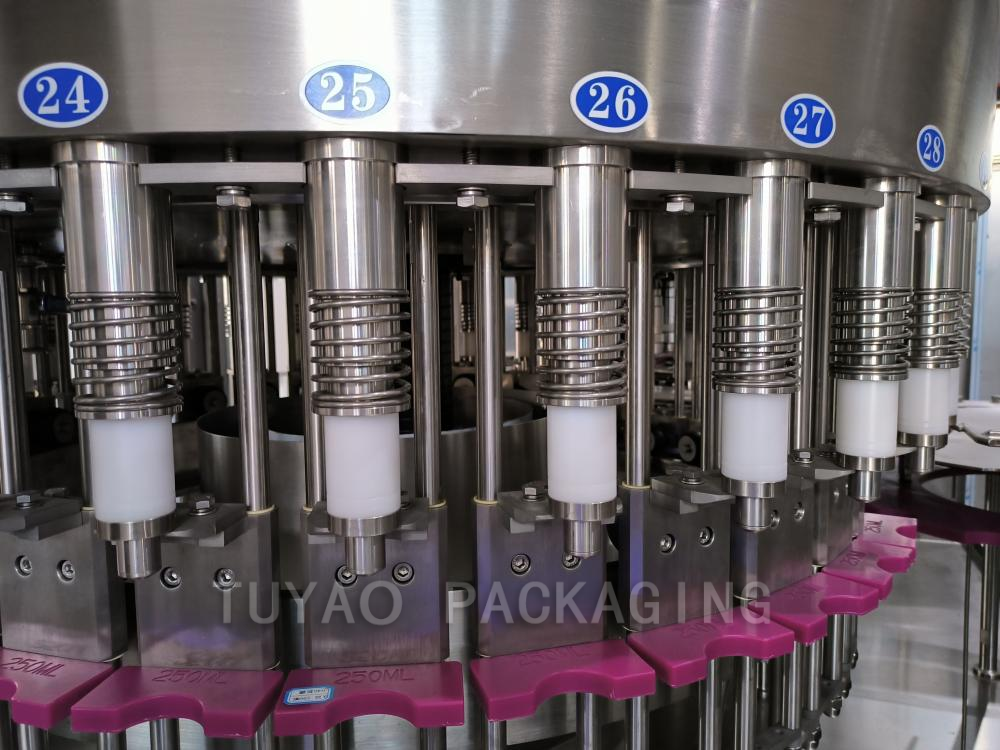
Core Principle: Gravity Filling
Gravity filling is the simplest and most mature filling technology. Water flows into empty bottles relying on natural gravity, with simple valve structures, fast running speed and low daily maintenance workload. The filling level is controlled by the height of the liquid in the filling tank, which provides consistent and accurate fill levels.
Full Process Flow
Raw water → multi-stage water treatment system (sand filter, activated carbon filter, reverse osmosis, UV sterilization) → PET bottle blowing → bottle rinsing with treated water → gravity filling → screw capping → labeling → date coding → shrink wrapping → palletizing → finished product
Key Equipment Notes
The water treatment system is the most critical part of a bottled water line, as it determines final product compliance with local drinking standards. A poorly designed water treatment system will lead to product safety issues and potential recalls. The integrated bottle rinsing filling capping machine is the core unit of the line, supporting stable high-speed continuous operation with low bottle breakage rate (usually less than 0.1%).
Advantages & Disadvantages
● Advantages: Low equipment cost, simple operation, easy maintenance, high production speed, low product waste
● Disadvantages: Only suitable for low-viscosity non-carbonated liquids, cannot handle viscous drinks or drinks with particles
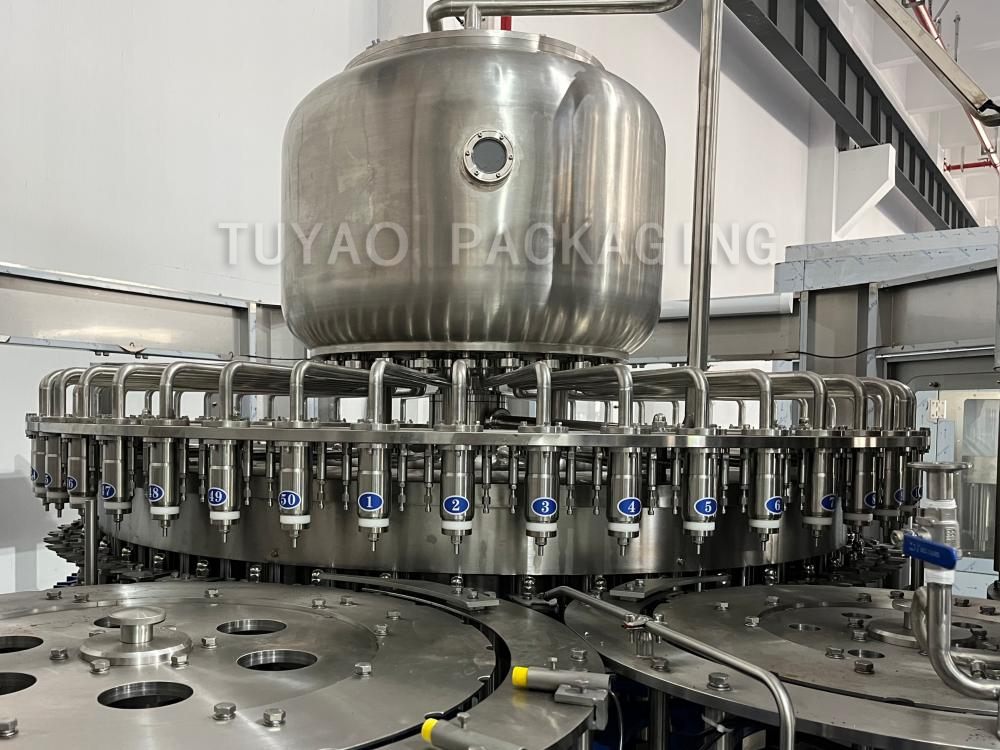
Juice contains sugar, fruit pulp and organic acid, which make it easy to ferment and spoil. Its higher viscosity also triggers heavy foaming during filling, which requires special filling valve designs. Two mature technical routes are widely applied in the juice industry, each with its own advantages and applicable scenarios.
2.1 Hot Filling (Mid-range Juice)
This is the most common technology for mid-range juice products. The juice is heated to 85–95°C before filling, which sterilizes both the juice and the bottle/cap during the filling process. After capping, the bottles are inverted for 30–60 seconds to sterilize the cap interior, then cooled to room temperature.
● Advantages: Lower equipment cost, simpler operation, proven reliable technology
● Disadvantages: High temperature damages part of the natural fruit flavor and vitamins, limited shelf life (6–9 months), requires heat-resistant PET bottles
2.2 Aseptic Cold Filling (Premium Juice)
This is the premium technology for high-end juice products. The juice is sterilized using ultra-high temperature (UHT) treatment for a few seconds, then cooled to ambient temperature. The filling process takes place in a fully sterile enclosed environment, using pre-sterilized bottles and caps.
● Advantages: Fully preserves original juice taste and nutrition, longer shelf life (12–18 months without preservatives), can use lighter standard PET bottles
● Disadvantages: Higher initial equipment investment, more complex operation and maintenance, stricter hygiene requirements
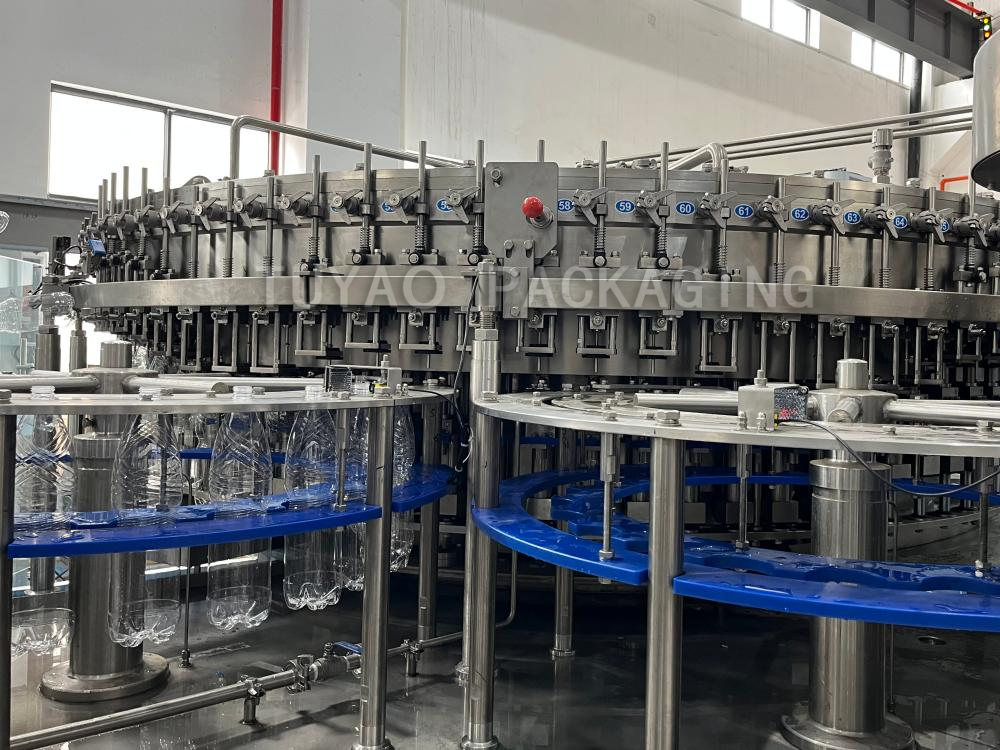
Carbonated soft drinks dissolve CO₂ inside liquid under pressure. Any pressure imbalance during filling will cause massive foam overflow and gas loss, leading to inconsistent product quality and high waste rates.
Core Principle: Isobaric Filling
Before filling, empty bottles are pre-filled with CO₂ to equalize their internal pressure with the pressure inside the filling tank. Once the pressures are equal, the filling valve opens and the liquid flows smoothly into the bottle without foaming. After filling, the valve closes and the excess CO₂ in the bottle headspace is released.
Special Supporting Units
● A carbonator for precise CO₂ dissolution into the beverage
● A warm-up tunnel after capping to eliminate bottle surface condensation and avoid label peeling
● Special anti-foaming filling valve designs to minimize foam generation
Advantages & Disadvantages
● Advantages: Maintains consistent CO₂ content in the product, low foam generation, high filling accuracy
● Disadvantages: Most complex filling technology, higher equipment cost, stricter pressure control requirements
| Quick Comparison Table | ||||
| Beverage Type | Filling Technology | Complexity | Initial Cost | Main Applicable Scenario |
| Bottled Water | Gravity filling | Low | $ | Mass daily fast production |
| Mid-range Juice | Hot filling | Medium | $$ | Mid-market fruit drinks |
| Premium Juice | Aseptic cold filling | High | $$$ | High-end premium juices |
| CSD / Soda | Isobaric filling | High | $$ | Carbonated beverage mass production |
If you haven’t confirmed the most suitable filling technology for your beverage formula, send your product parameters including viscosity, pH value and required shelf life to our engineering team at TUYAO PACKAGING. We will recommend the most cost-effective bottling line solution for free, based on your specific needs.
 EN
EN
